
So, what’s the real cost of getting professional drone photography done? For a typical real estate listing, you’re generally looking at a price tag between $250 and $750. This gets you a solid package of high-quality aerial photos that can make a property stand out.
Of course, if you're talking about more involved projects—think cinematic videos for a luxury estate or a large commercial property—the investment can easily climb from $800 to over $2,000. It all comes down to what you need and how complex the job is.
Decoding Drone Photography Prices
When you hire a drone photographer, you're not just paying for someone to fly a camera around. You're investing in a powerful marketing tool that tells a story ground-level shots just can't capture. It’s about showing off the property's scale, the flow of the land, and how it fits into the neighborhood.
This isn't just a niche service anymore; it's becoming a cornerstone of modern real estate marketing. The commercial drone market is absolutely exploding, with projections showing a leap from $4.758 billion to an eye-watering $24.76 billion by 2035. A huge piece of that growth comes from real estate agents who’ve seen the results firsthand.
Why the boom? Because it works. Listings with professional aerials have been shown to get up to 68% more views and sell 32% faster. Those are numbers that justify paying a premium for a skilled, certified pilot. You can dig deeper into these trends in this commercial drone market report.
Common Service Tiers and What to Expect
To make things easier, most drone photographers offer tiered packages. This helps you quickly find a service that fits both your marketing goals and your budget. It’s a straightforward way to see what you get for your money.
Let’s break down what these packages usually look like for a real estate shoot.
Key Takeaway: Choosing the right package isn't just about cost. It's about matching the visual assets to the property's value and marketing strategy. A luxury estate demands a cinematic video, while a standard suburban home may only need a clean set of aerial photos.
The table below gives you a clear idea of what to expect at different price points, so you can make a smart choice from the get-go.
Typical Drone Photography Packages And Price Ranges
Here's a snapshot of common packages you'll find on the market. This should give you a good baseline for what different tiers include and what they're best suited for.
| Package Tier | Average Price Range | Common Deliverables | Best For |
|---|---|---|---|
| Photos Only (Basic) | $250 - $450 | 5-10 professionally edited high-resolution aerial photos. | Standard residential listings, vacant land, or budget-conscious projects needing a simple aerial perspective. |
| Photos & Video (Standard) | $500 - $950 | 10-20 edited photos plus a 60-90 second edited 4K video with music. | Most residential properties, showcasing both key features and the overall property flow. |
| Premium Combo (Elite) | $1,000 - $2,500+ | 20+ photos, a 2-3 minute cinematic video, branding, and potential add-ons like twilight shots. | Luxury estates, large commercial properties, or high-value listings that require top-tier marketing assets. |
Ultimately, these packages are designed to provide clear options. Whether you need a few stunning photos or a full-blown cinematic experience, there’s a package out there that fits the bill.
What Really Drives Drone Photography Costs
So, you get two quotes for an aerial shoot. One is $300, and the other is $3,000. Why the huge gap?
It’s not just a random number pulled out of thin air. The price of drone photography is a direct reflection of the pilot's skill, the quality of their gear, and the complexity of the job itself. Think of it like this: you can buy a flat-pack bookcase or you can hire a master carpenter to build you a custom one. Both hold books, but the craftsmanship, materials, and final result are in completely different leagues.
When you invest in a professional, you're not just paying someone to fly a camera around. You're hiring a licensed expert who navigates a maze of federal regulations, uses thousands of dollars worth of equipment, and delivers a polished final product that makes a property shine and protects your own reputation. Let's break down exactly what goes into that final price tag.
This infographic gives a great overview of how different services stack up.
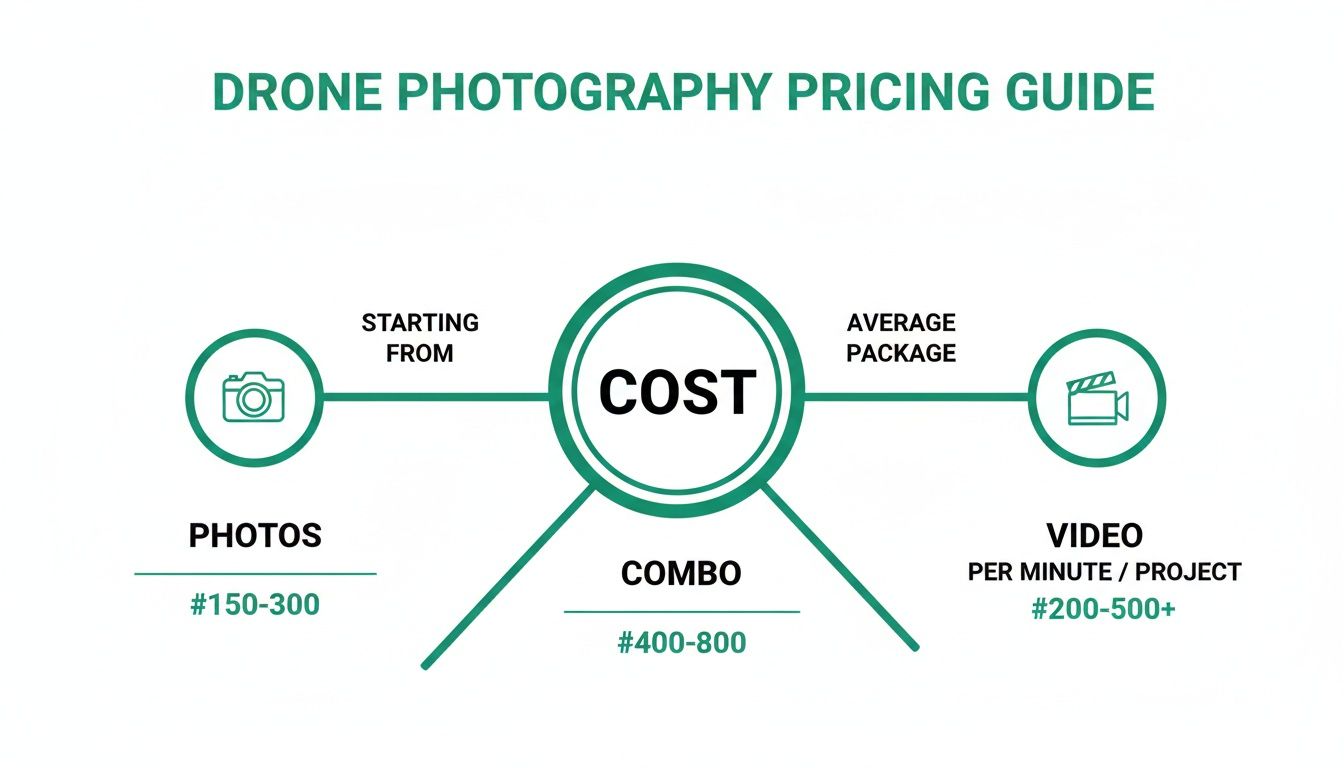
As you can see, the price climbs from simple photo packages to more involved video shoots and combo deals. Each one demands a different level of expertise and time.
Pilot Experience and Certification
Honestly, the pilot is the single biggest factor affecting the cost. You're not just renting a drone; you're hiring a federally licensed professional. A pilot with an FAA Part 107 certification has proven their knowledge of airspace rules, weather patterns, and safety protocols. They are legally cleared to fly for commercial work.
This certification is non-negotiable. Hiring an uncertified pilot is a massive gamble, putting you and your client at serious legal and financial risk. Beyond the license, sheer experience is what separates the pros from the amateurs. A seasoned pilot knows how to handle gusty winds, compose breathtaking shots, and fly safely around people and property. They get the job done right and efficiently, while a rookie might struggle, waste your time, or deliver shaky, unusable footage.
Expert Insight: A great drone pilot is an aerial cinematographer. They understand light, angles, and how to tell a story from above, turning a standard property view into a captivating visual experience.
Drone and Camera Equipment Quality
All drones are definitely not created equal. The tech inside these machines has a direct and immediate impact on the final photos and videos. A pro's fee is partly covering their investment in high-end gear, which can easily run into the thousands.
Here's what that investment gets you:
- Bigger, Better Sensors: Top-tier drones like the DJI Mavic 4 Pro use larger camera sensors. Just like in a regular camera, a bigger sensor captures more light and detail, which means your images are sharper, clearer, and have richer colors, especially in tricky lighting. Cheaper drones produce photos that can look grainy and washed out.
- Pro-Level Camera Features: Professionals shoot in RAW format. This gives them total control in the editing room to fine-tune colors and exposure without degrading the image quality. Their drones also shoot in ultra-high-definition video formats like 4K or 5.2K, delivering cinema-quality motion.
- Safety and Stability: Professional drones are built to be workhorses. They have superior stability in wind, advanced obstacle avoidance sensors, and rock-solid GPS. This means smoother video, safer flights, and peace of mind.
Want a deeper dive into the gear? Check out our guide on the best drones for real estate photography.
Flight Complexity and Time On-Site
The property itself and its location play a huge role in the price. Shooting a simple suburban house on a calm, sunny day is one thing. Capturing a downtown high-rise in controlled airspace is another challenge entirely.
Several things can make a flight more complex:
- Airspace Restrictions: Is the property near an airport, a military base, or in a busy city center? Flying in these areas often requires special authorization from the FAA, which takes time and paperwork to secure.
- On-Site Hazards: Power lines, towering trees, and close-by buildings are all obstacles that require meticulous planning and a steady hand to navigate safely.
- Time Needed: A sprawling estate will take longer to cover than a small bungalow. If a project requires a variety of shots—stills from multiple angles, sweeping video clips, and a 360-degree orbit—it will naturally demand more time on-site, which factors into the cost.
Post-Production and Editing
The pilot's job isn't over when the drone lands. This is where the real magic happens. Post-production is the process of taking all that raw footage and transforming it into a stunning, market-ready asset. This is a detailed, time-consuming step that includes color correction, sharpening images, removing blemishes (like a car in the driveway), and piecing together a compelling video.
For video, the editing is even more involved. It means syncing clips, choosing the right music, adding smooth transitions, and incorporating your branding, like a logo or contact info. Whether you need a simple, clean edit or a full-blown cinematic tour will have a direct impact on the final price. A good editor can make great footage absolutely unforgettable.
How Drone Photographers Structure Their Pricing
When you get a quote for drone photography, it helps to understand what’s going on behind the scenes. It's not just a number pulled out of thin air. Much like a contractor breaks down costs for materials and labor, a drone pilot builds their price using a few common models.
Most pros pick the structure that best fits the job, so you'll see a few different approaches. Let’s pull back the curtain on these pricing models so you know exactly what you’re looking at next time a proposal lands in your inbox.
Per-Image Pricing
The most straightforward way to charge is per-image pricing. It’s exactly what it sounds like: you pay a set price for each photo you decide to keep. This model is perfect when you know you only need a handful of specific shots.
Think about a developer who needs one stunning "hero" shot of a completed skyscraper for their portfolio, or a real estate agent who just wants to add three aerials to an existing gallery of ground-level photos. It's simple, direct, and you only pay for what you absolutely need.
The catch? It can get pricey fast. If your project requires 10 or 20 images, you'll almost always find better value in a package deal.
Hourly Rates
Charging by the hour is another popular method. This approach works best for jobs where the scope is a bit fluid, like covering a live outdoor event, documenting weekly progress on a construction site, or shooting a massive commercial property with multiple points of interest.
With an hourly rate, you're paying for the photographer's time on location—from setup and pre-flight checks to actual flying and packing up. A crucial detail to confirm is whether that rate includes editing time or if post-production is billed as a separate line item.
The biggest plus here is flexibility. If unexpected weather rolls in or you decide you need more angles on the fly, the hourly model can easily adapt. The downside is potential budget creep if the project isn't clearly defined from the get-go.
We dive deeper into this topic in our guide explaining how much photographers charge per hour.
Project-Based Packages
For real estate, project-based packages are king. This is the most common model you'll encounter, bundling a specific set of deliverables for one flat fee. Think of it as the value meal of drone photography—you know exactly what you’re getting and exactly what it will cost.
A typical real estate package often includes:
- A set of 10-15 high-resolution aerial photos
- A 60-second cinematic video in 4K
- Professional editing and color correction
- Optional add-ons like property line overlays or a twilight shoot
This is a win-win. The client gets cost certainty, which is fantastic for budgeting, and the photographer can price their work based on the total value provided, not just the minutes spent in the air.
Value-Based Pricing
Finally, we have a more sophisticated approach: value-based pricing. This model isn't tied to hours worked or the number of photos delivered. Instead, it’s connected to the financial impact the images will have for the client.
Here's the logic: a set of incredible aerials for a $3 million luxury waterfront estate has the potential to generate a much larger commission than the same effort for a $300,000 suburban home. The value the photos create is dramatically different.
In these cases, the photographer prices their work as a reflection of the significant value it helps unlock. While you won’t see this for most standard listings, it’s a common strategy for high-end commercial work, luxury properties, and major advertising campaigns where the imagery is a cornerstone of the sales strategy.
To help you see how these models stack up, here’s a quick comparison.
Comparing Drone Photography Pricing Models
This table breaks down the different pricing structures to show the pros of each for both the client and the drone pilot.
| Pricing Model | How It Works | Pros For Client | Pros For Photographer |
|---|---|---|---|
| Per-Image | A flat fee is charged for each individual photo selected. | Pay only for what you need; great for small, specific jobs. | Simple to quote and bill; higher potential profit per image. |
| Hourly Rate | Billed based on the total time spent on-site (and sometimes editing). | Flexible for dynamic projects or unclear scopes. | Compensated for all time spent, including overages or delays. |
| Project Package | A bundled set of deliverables (e.g., 15 photos + 1 video) for a fixed price. | Budget certainty and predictable costs; often the best value. | Streamlined workflow; easier to sell and manage expectations. |
| Value-Based | Pricing is determined by the project's impact on the client's revenue or goals. | The investment directly aligns with the expected business outcome. | Higher earning potential on high-impact, high-stakes projects. |
Ultimately, the best model depends entirely on the project's goals. Knowing how they work puts you in a much better position to understand your quote and choose the right partner for the job.
Real World Pricing Scenarios For Real Estate
Okay, let's move beyond the theory and see how this all plays out in the real world. Knowing what drives costs is one thing, but seeing the numbers attached to actual properties makes planning your budget a whole lot easier. The truth is, drone photography pricing isn't a one-size-fits-all deal; the property itself sets the stage for the complexity, the time required, and, ultimately, the final price tag.
To give you a clearer picture, we'll walk through three very different types of properties. Each scenario breaks down a realistic price range and shows how things like flight complexity, risk, and the final deliverables shape what you'll invest.
Standard Suburban Home
First up, picture a classic 2,500-square-foot home nestled in a quiet, spacious subdivision. This is the bread and butter of real estate drone photography—the most common and straightforward job a pilot will encounter. The flight path is typically low-risk with few obstacles like power lines or dense trees, and it's almost always in uncontrolled airspace, meaning no special FAA permissions are needed.
For a house like this, a basic package is usually all you need to capture those key aerial shots that make a listing pop.
- Typical Price Range: $250 – $450
- Deliverables: 10-15 professionally edited, high-resolution photos.
- Cost Breakdown: This price covers the essentials: about an hour of the pilot’s time on-site, standard photo editing, top-notch equipment, insurance, and general business overhead. Travel costs are minimal, and the post-production work is pretty quick.
This kind of package is perfect for giving a standard listing a professional boost. It beautifully showcases the property's layout, the size of the yard, and how it fits into the neighborhood.
Sprawling Luxury Waterfront Estate
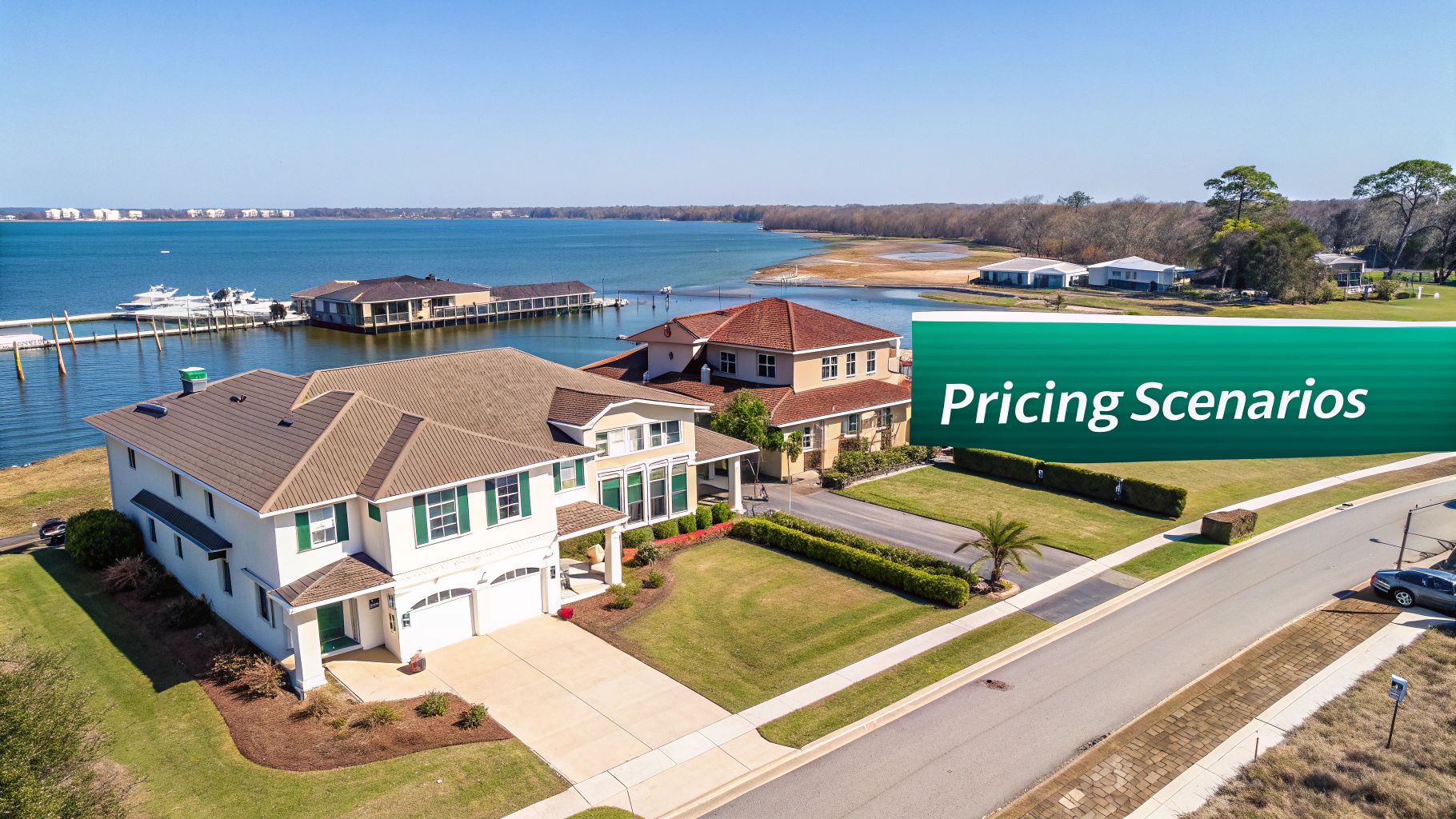
Now let's jump to the high end with a 7,000-square-foot luxury estate right on a lake or coastline. This is an entirely different ballgame. The sheer size of the property demands more flight time to capture everything—the expansive grounds, the boat docks, the intricate architectural details. And with water involved, the risk level immediately goes up, requiring a pilot with serious skill and steady hands.
A multi-million dollar listing demands marketing materials that scream premium, and the aerials are no exception.
- Typical Price Range: $1,200 – $2,500+
- Deliverables: 20-30+ stunning HDR photos, a 2-3 minute cinematic 4K video with custom branding, and maybe even a dramatic twilight shoot to capture that perfect sunset glow.
- Cost Breakdown: The much higher price reflects a lot more work: 2-3 hours of flight time, advanced cinematography skills, far more intensive video editing, and higher insurance liability to cover a high-value property.
Key Insight: For luxury properties, investing in high-end aerials isn't just a line item expense—it's a critical marketing tool. The visuals have to match the property's prestige to attract the right kind of buyer and justify the asking price.
Large Commercial Property
Finally, let’s look at a large commercial site, like a shopping center or an industrial park. Here, the goal is less about cinematic beauty and more about practicality. The client needs to showcase the property's scale, accessibility, and proximity to major highways and local infrastructure.
The scope is significantly larger, often requiring multiple flights and careful planning to fly safely around employees, customers, and traffic.
- Typical Price Range: $800 – $3,000+
- Deliverables: A full set of high-resolution photos showing clear property boundaries, parking capacity, and loading docks. This often includes functional assets like orthomosaic maps or a straightforward, informative video tour.
- Cost Breakdown: This cost is driven by the extended time on-site, the potential need for a second person (a visual observer) for safety, airspace authorizations, and detailed post-production work like creating property line overlays.
It's also worth noting how specialized techniques can affect the final investment. For instance, drone tilt photography, a fast-growing niche that captures dynamic, angled shots of a building's elevation, is becoming increasingly popular. Basic tilt shoots might add $300-$800 to a project, but more comprehensive packages can easily reach $1,500 or more. It’s an investment that pays off, as professional drone photos can help lift final sale prices. You can explore more on this trend and its market potential on GlobeNewswire.
How To Create Profitable Drone Service Packages
To turn your drone skills into a real business, you have to stop thinking about one-off gigs and start thinking like a marketer. The secret lies in designing service packages that are not only profitable for you but also incredibly simple for a client to understand and approve. When done right, good packages eliminate decision-making headaches for real estate agents and show them exactly what they're getting for their money.
Remember, you're not just selling a service; you're selling a solution. You’re giving agents a powerful marketing tool that helps them sell properties faster and for a better price. By packaging your work thoughtfully, you steer clients toward the best fit for their listing, which makes life easier for everyone.
Structuring Tiered Offerings
One of the smartest ways to present your services is with a tiered pricing structure. Think along the lines of Starter, Pro, and Elite, or Bronze, Silver, and Gold. This approach works because it meets different clients where they are, accommodating various needs and budgets. It makes you a viable option for everything from a standard suburban home to a sprawling luxury estate.
It’s just like buying a car. There's a base model, a popular mid-range option with some nice upgrades, and the fully-loaded premium version. Most people naturally drift toward that middle option, as it usually offers the best bang for the buck.
Here’s what that looks like in the real estate world:
- Starter Package (The Essentials): This is perfect for smaller homes or vacant land listings. It might include 10-15 high-resolution aerial photos, all professionally edited and delivered within 48 hours. It’s your no-frills, get-the-job-done option.
- Pro Package (The Standard): This should be your bread and butter—the one you want most clients to pick. You can bundle 20-25 stunning aerial photos with a 60-second 4K cinematic video, complete with licensed music and some basic agent branding.
- Elite Package (The Works): Save this for the high-end, jaw-dropping properties. This all-inclusive package could feature 30+ photos (including those magical twilight shots), a longer 2-3 minute cinematic video, property line overlays, and priority, next-day turnaround.
A tiered model makes your drone photography prices clear and predictable, which agents absolutely love. It also gives you a built-in way to upsell clients.
The Psychology Of Upselling With Add-Ons
Once you've locked in your core packages, you can boost your average sale by offering a few high-impact add-ons. The trick is to offer services that naturally complement each other and provide a ton of extra value. It’s far more effective to bundle things together than to try and sell every service individually.
For instance, don't just offer drone photos in a vacuum. Bundle them with your standard ground-level photography. An agent who needs both will immediately see the benefit of hiring one pro to handle everything, which guarantees a consistent, professional look across all their marketing.
Key Insight: Bundling services shifts the client's focus from cost to convenience and value. When an agent can get drone photos, interior shots, and a 3D tour from a single, trusted source, they are often willing to pay a premium for the streamlined experience.
Consider offering these powerful add-ons:
- Interior Photography: The most obvious pairing. Create a "Complete Listing Package" that covers the property from the air and on the ground.
- 3D Matterport Tours: An immersive add-on that pairs perfectly with video to create a comprehensive digital showing experience.
- Twilight Shoots: Offer this as a premium add-on, especially for your top-tier package, to capture those dramatic, eye-catching shots that make luxury properties pop.
- Property Line Overlays: A practical and incredibly useful tool, particularly for listings with large or oddly shaped lots that need clarification.
Crafting A Professional And Clear Quote
Your quote is so much more than a price list. It's a professional document that sets clear expectations and protects you from scope creep down the line. A detailed, easy-to-read quote communicates your value and prevents frustrating misunderstandings. There should be zero ambiguity.
Every single quote you send out needs to clearly define the following:
- Deliverables: Get specific. Don't just say "drone photos." Instead, write "15 high-resolution, professionally edited aerial photos."
- Usage Rights: State exactly how the client can use the images (e.g., "for MLS, social media, and web marketing for the duration of the listing").
- Revision Policy: Outline your process for edits. You might include one round of minor video edits for free, with any additional changes billed at an hourly rate.
- Turnaround Time: Be crystal clear on your timeline. For example, "Photos delivered within 24 hours, video within 72 hours."
- Payment Terms: Lay out your payment schedule (e.g., "50% deposit required to book, with the remaining 50% due upon delivery").
By building professional packages and backing them up with clear quotes, you create a sustainable business built on transparency and value. This ensures your drone photography prices are both profitable for you and compelling for your clients.
How To Hire The Right Drone Photographer
For any real estate agent or marketer, picking the right drone pilot is a make-or-break decision. It’s not just about getting a few cool aerial shots; it's about showcasing a property in its best light and, frankly, protecting your business and your client.
Before you even get to the pricing conversation, dive into their portfolio. You're looking for more than just pretty pictures—you need to see consistency, a creative eye, and a style that clicks with the kind of properties you sell. Are the images crisp? Is the lighting great? Does the composition tell a story? A strong portfolio is your first and best clue that you’re dealing with a pro.
Verify The Non-Negotiables
Once you like their work, it’s time to check off two critical items. These aren't suggestions; they are the absolute bare minimum for any legal, professional drone operation.
FAA Part 107 Certification: Think of this as a driver's license for commercial drone pilots. In the United States, anyone flying a drone for business must have this certification. A pilot flying without it is breaking the law, and that puts you and your client in a very risky position. Don't be shy—ask to see their certificate.
Liability Insurance: Accidents are rare, but they happen. A professional pilot will carry a serious liability insurance policy. This coverage protects everyone—you, the homeowner, and your client—if something goes wrong. You can get a deeper understanding of why this matters in our guide to business insurance for photographers.
If a pilot can't immediately show you proof of both, walk away. A true professional will have this documentation ready to go.
Crafting A Clear Project Brief
Want an accurate quote? You need to provide a clear brief. A fuzzy request like "I need some drone shots" will only get you a fuzzy, often inaccurate, price. The goal is to give every photographer the same set of instructions so you can compare their quotes apples-to-apples.
Pro Tip: A detailed brief does more than just get you a fair price. It helps the photographer plan the shoot down to the last detail, which ultimately leads to much better results. It’s all about setting clear expectations right from the start.
Make sure your brief covers the basics:
- Property Address: This is crucial so the pilot can check for airspace restrictions (like being near an airport).
- Specific Deliverables: Be precise. For example, "15 high-resolution photos and one 60-second 4K video."
- Desired Shot List: Call out the money shots. Do you need to highlight the brand-new pool, the solar panels, or the fact that it backs onto a beautiful park?
- Deadline: When do you need the final, edited files in your hands?
When it comes time to talk money, try to think about long-term value, not just the cost of a single shoot. Instead of haggling over one job, ask about package deals for multiple listings or bundled services. Finding a reliable, talented drone pilot you can work with again and again is worth far more than saving a few bucks on a one-off project.
A Few Final Questions on Drone Photography Prices
Even with a clear idea of the numbers, a few practical questions always pop up. Whether you're a real estate agent trying to budget or a photographer setting up your packages, let's clear up some of the common details.
How Long Does a Typical Drone Shoot Take?
For most standard homes, you can expect the drone pilot to be on-site for about 45 to 90 minutes. This isn't just flight time; it includes setting up, running through pre-flight safety checklists, capturing all the necessary angles, and then packing everything away securely.
If you're dealing with a larger property, like a sprawling luxury estate or a commercial complex, the timeline expands. These kinds of projects can easily take 2-3 hours, sometimes even longer, to get all the right shots.
Are Drone Photos Edited After the Shoot?
You bet they are. Post-production is a non-negotiable part of any professional drone photography package and is always baked into the price. The raw images straight from the drone's camera are intentionally a bit flat—it gives the editor maximum flexibility.
A pro pilot will take those files and bring them to life. They'll adjust the colors, balance the light and shadows, sharpen the important details, and make sure every image pops. It's this editing magic that turns a good photo into a "wow" photo for your marketing.
Key Takeaway: The price you're quoted almost always includes professional photo editing. This isn't just slapping on a filter; it's a meticulous process that makes the property look its absolute best, which can make a huge difference in how buyers react.
Do I Need to Be On-Site During the Shoot?
It's completely up to you, but it’s not required. As long as you give your photographer a clear idea of what you want—maybe a shot list or a quick brief—most seasoned pilots are perfectly comfortable handling the shoot on their own.
That said, some agents prefer to be there. It can be useful if you want to give feedback on the fly or point out a specific feature of the property you absolutely need to capture from the air.
Ready to find a verified professional for your next listing? PropPhoto is the leading marketplace connecting real estate agents with top-tier photographers and drone pilots across the country. Browse portfolios, compare services, and book with confidence at https://propphoto.com.

