
Figuring out what to charge for real estate photography can feel like a moving target. You’re juggling your own business costs, what the local market will bear, and the massive value you bring to the table. Most standard shoots end up landing somewhere between $175 and $550, but the real trick is building packages that not only cover your expenses but also make sense to the agents you want to work with.
Understanding Your Value in the Real Estate Market
Before you even think about numbers, you have to get one thing straight: you're not just selling pictures. You are a marketing partner, and your work is an investment in an agent's success. Those photos are the single most important asset for any property listing, period.
Think about it. What stops a potential buyer from endlessly scrolling? A great photo. It's the visual handshake that makes the first impression and gets them to book a showing. Without compelling images, a beautiful home can easily get lost in the noise of a crowded online market.
The Tangible Impact of Professional Photos
Your skills deliver real, measurable results for your clients. This isn't just a gut feeling; there's hard data to back it up. When an agent hires you, they're paying for a proven tool that helps sell a home faster and for more money.
The stats are pretty eye-opening. Listings with professional photos consistently crush those with amateur shots. They can pull in up to 118% more online views—a huge advantage right out of the gate. More views mean more interest, which leads to more showings and, ultimately, a faster sale. In fact, these homes often sell 32% faster than comparable properties. That kind of efficiency is exactly what agents and their sellers are looking for.
And it’s not just about speed. Your work adds actual dollars to the bottom line. Professionally photographed homes sell for an average of $3,000 to $11,000 more. When you frame your service this way, the conversation instantly shifts from being a cost to being a no-brainer investment.
Key Takeaway: Your pricing shouldn’t just cover your time and gear. It has to reflect the serious financial value you create for your clients—faster sales, higher offers, and a stronger brand for the agent.
Core Pricing Models at a Glance
Once you’ve internalized your value, you can start looking at how to structure your rates. We’ll get into the weeds on these later, but here’s a quick rundown of the main approaches people take:
- Cost-Plus Pricing: This is the business-first method. You calculate your total Cost of Doing Business (CODB) and then add your desired profit margin on top. It’s a straightforward way to make sure every single job is profitable.
- Market-Driven Pricing: This approach is all about research. You see what other photographers in your city are charging and position yourself accordingly. You might decide to be slightly above, right at, or just below the average, depending on your experience and what you offer.
- Value-Based Pricing: This is the most confident strategy. You're pricing your services based on the immense value you deliver. For a high-end luxury listing, for example, your fee is tied directly to the result you help the agent achieve—a faster, more profitable sale.
If you’re just getting your feet wet, a mix of cost-plus and market-driven pricing is usually the most practical place to start. It guarantees your bills are paid while keeping you competitive enough to build a solid client list. For those just beginning this journey, our guide on how to become a real estate photographer offers a ton of foundational tips.
To give you a clearer picture of what market-driven pricing looks like across the country, here’s a quick breakdown.
Quick Guide to Standard Real Estate Photography Pricing
This table gives you a general idea of what agents are paying for a standard package of 20-35 photos based on the type of market they're in.
| Market Tier | Average Price Range (Per Standard Listing) | Key Factors |
|---|---|---|
| Tier 1 (Major Metro) | $250 - $550+ | High cost of living, intense competition, higher property values. Think NYC, LA, SF. |
| Tier 2 (Mid-Sized City) | $175 - $350 | Moderate competition, solid demand, average property values. Common in most US cities. |
| Tier 3 (Rural/Small Town) | $125 - $225 | Lower operating costs, less competition, but also lower property prices and budgets. |
Use these numbers as a starting point. They're not rigid rules, but they provide a solid benchmark to help you see where your own pricing might fit in as you begin to factor in your specific costs and business goals.
Figuring Out Your Real Cost of Doing Business
Profit doesn't just happen. It's built on a solid understanding of what it actually costs you to show up and do the job. Before you can dream up a price list, you need to get real about your Cost of Doing Business (CODB). This number is your foundation—the absolute minimum you need to cover just to keep the lights on.
It’s so easy to get this wrong. A lot of photographers just think about the obvious stuff, like a new lens or their Adobe subscription. But your true costs run much deeper, from the insurance you hope you never need to the self-employment taxes that sneak up on you. Miss these, and you're on the fast track to burnout.
Tallying Up Your Business Expenses
Let's get granular and break down every single cost. The easiest way to do this is to split them into two buckets: fixed costs and variable costs. Fixed costs are the bills that show up every month or year, no matter how many houses you shoot.
- Software Subscriptions: This is your Adobe Creative Cloud, your gallery delivery platform, your accounting software—all the digital tools of the trade.
- Insurance: Non-negotiable. You need liability coverage and protection for your gear.
- Marketing & Admin: Think website hosting, your domain name, business cards, or even the portion of your cell phone bill used for work.
- Education: Any workshops, online courses, or memberships that keep your skills sharp.
Then you have your variable costs. These change depending on how busy you are and pop up with each job you book.
- On the Road: Gas, mileage on your car, and routine maintenance. Every trip adds up.
- Hired Help: If you outsource editing or use a virtual assistant, their fees go here.
- Client Relations: Grabbing coffee with an agent or sending a small thank-you gift after a big project.
And don't forget the elephant in the room: gear depreciation. That shiny new $3,000 camera isn't going to last forever. If you plan on upgrading every three years, you should be setting aside $1,000 a year just for that. Once you have all these numbers, you’ll have a clear picture of your annual CODB.
For a really detailed list of these expenses, check out our guide on how to start a real estate photography business.
Once you've nailed down your CODB, you can start thinking about which pricing strategy makes sense for you.
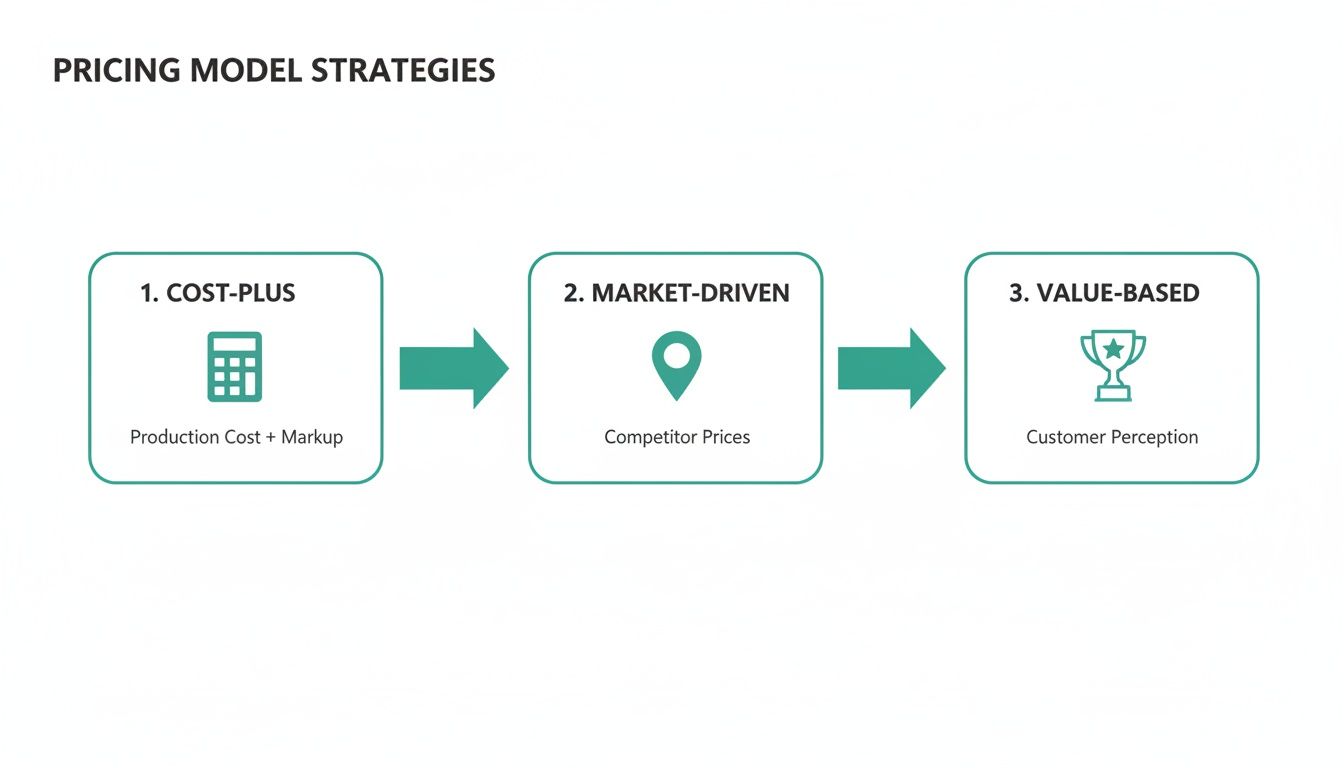
As you can see, no matter which path you take—cost-plus, market-driven, or value-based—it all starts with knowing your numbers.
Your Time Is Your Most Valuable Asset—Don't Give It Away
Your expenses are just one part of the puzzle. The other, arguably more important part, is your time. All of it. The biggest mistake I see photographers make is only charging for the hour they spend on-site. This completely ignores all the work that happens before and after the camera comes out of the bag.
A one-hour photoshoot is never a one-hour job. To set a fair price, you have to account for every single minute you spend on that project, from the first email to the final delivery.
Let’s be realistic about what a "standard" shoot actually involves:
- Prep & Comms (30 mins): Back-and-forth emails, calls to confirm access, and scheduling.
- Travel (60 mins): At least 30 minutes each way is a safe bet for most areas.
- The Shoot (60 mins): This is the part the client actually sees.
- Editing & Culling (120 mins): This is where the magic happens, and it's often the biggest time sink.
- Admin & Delivery (30 mins): Uploading files, crafting the delivery email, and making sure the agent gets everything.
For this simple job, your total time commitment is five hours. If you only bill for the one hour on-site, you’re literally working four hours for free. When you know your true time investment, you can set a baseline hourly rate that ensures every single part of your effort is paid for. That’s how you build a profitable business that lasts.
Analyzing Your Local Market to Price Competitively
Once you’ve nailed down your own costs, it’s time to look outward. Your pricing can't exist in a bubble—it has to make sense in your city and for the neighborhoods you serve. Getting a handle on your local market is how you find that pricing sweet spot where you're competitive enough to get noticed but premium enough to reflect your quality.
This part is all about strategic research, not just copying what everyone else is doing. You're gathering intel to position your business for success. The goal isn’t to join the race to the bottom, where everyone keeps undercutting each other until no one can make a decent living. Instead, you're looking for the market standard so you can confidently price yourself based on the actual value you bring to the table.
Finding Your Local Competitors
First things first, you need to figure out who you’re actually up against. The best way to do this is to think like a real estate agent. How would they find a photographer?
Start with a simple Google search for "real estate photographer in [Your City]". Go past the first page of results, looking for photographers with polished, professional websites and strong portfolios. These are the people agents are already finding and hiring.
But don't stop there. Platforms like PropPhoto are a goldmine for this kind of research. You can browse photographer profiles in your specific area and see exactly how they present their work, the services they offer, and sometimes even their starting prices. Your goal is to create a list of five to ten established, successful photographers in your area. These are your real competitors.
Analyzing What They Offer and How They Charge
With your competitor list in hand, it’s time to play detective. Go through each photographer’s website with one goal: to understand their packages and pricing structure. Most won't slap their prices on the homepage, but you can usually find a "Pricing" or "Services" page that gives you a pretty clear idea of how they operate.
Keep an eye out for these key details:
- Package Tiers: Do they offer different levels, like a "Standard" and "Luxury" package?
- Photo Count: How many images do they include in their base packages? Is it 25, 35, or more?
- Add-On Services: What extras are they selling? Make a note of everything from drone shots and video tours to twilight sessions and floor plans.
- Property Size Tiers: This is a big one. Do their prices scale with the home's square footage?
If you can’t find any pricing online, don't be afraid to send a polite inquiry from a personal email address, posing as a homeowner looking for photos. This can give you direct access to their price sheet and show you how they communicate with potential clients.
Pro Tip: I highly recommend creating a simple spreadsheet to track what you find. List each competitor, their package names, what’s included, and the price. This will give you a clear, at-a-glance view of the entire market landscape.
This research helps you understand what local agents expect to pay and what they expect to get for that price. The national average for a standard real estate shoot hovers around $230, but this number can be misleading. Location changes everything.
For example, photographers in a hot market like Los Angeles might charge between $318 and $330, while those in smaller markets like Phoenix average closer to $208 to $215. As you can see, knowing your city's specific pricing climate is non-negotiable. You can read the full research about these geographic pricing differences to get a better sense of how things vary.
Adjusting for Local Economic Factors
Finally, you need to factor in the health of your local economy. A booming real estate market with high home values can absolutely support higher photography rates. In these areas, agents are often less sensitive to price because great marketing is essential when the stakes are so high.
On the flip side, in a slower market or a city with a lower cost of living, you'll need to be more strategic. This doesn’t mean you have to be the cheapest—far from it. It means you have to be exceptional at communicating your value, proving to agents why your work is a smart investment, even when their budgets are tighter. Your market analysis gives you the context you need to set prices that are profitable for you and perfectly justifiable to your clients.
Building Packages and Add-Ons That Boost Your Income
This is where the real money is made. Moving from selling one-off photo shoots to offering smart packages is how you transition from being just another photographer to a vital marketing partner for your clients. A single shoot pays the bills, but a well-designed package turns a simple job into a high-value project that solves a real estate agent’s biggest marketing headaches.
When you bundle your services, you’re not just making life easier for the agent; you’re dramatically increasing your average sale. Instead of having them cherry-pick services, you guide them toward complete solutions that fit different types of listings. It’s a subtle shift that positions you as an expert who understands their needs, not just a vendor taking an order.
Crafting Your Core Photography Packages
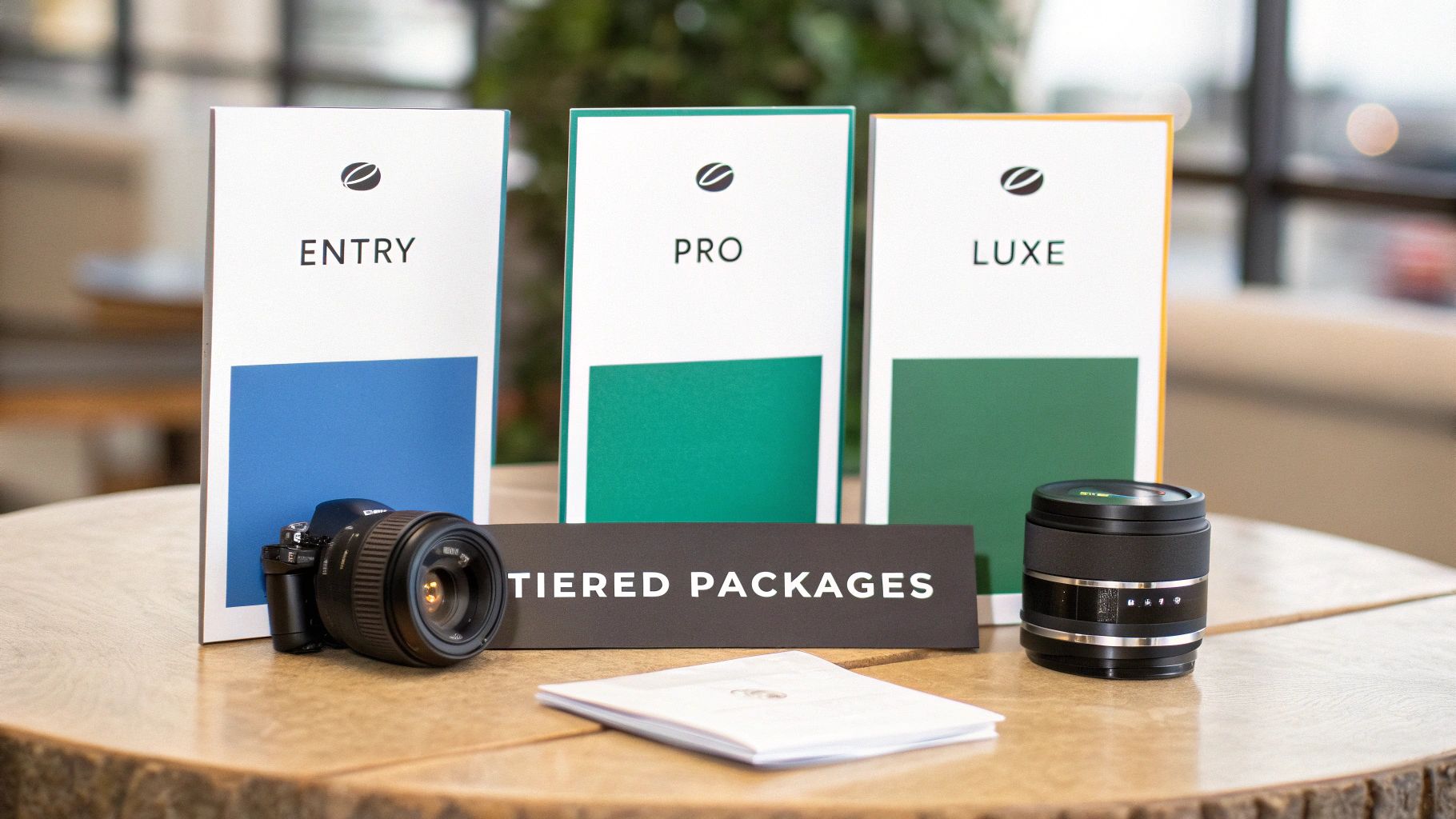
The easiest and most effective way to present your services is with a tiered "good, better, best" model. It’s a classic for a reason—it works. This structure naturally guides clients, often making the middle-tier package the most attractive and logical choice. The key is making each tier a clear and valuable step up from the one before it.
Think of it as creating a logical ladder for your clients to climb based on the property they're listing.
The 'Essential' Package: This is your bread and butter, perfect for smaller homes, condos, or standard rental listings. It should cover the absolute must-haves: a solid set of professionally shot and edited photos (think 25 images) that will look great on the MLS. It’s the clean, professional, no-fuss option.
The 'Pro' Package: This is where you want most of your clients to land. It’s designed for the average single-family home and should feel like a significant upgrade. You’ll include more photos (35-40 images) and bundle in a high-impact service like drone photography or a 2D floor plan. Including something like aerials here makes the jump from your basic package feel like a no-brainer.
The 'Luxe' Package: This is your premium, all-in-one marketing powerhouse for high-end listings or unique properties that need to make a splash. Here, you bundle everything from the 'Pro' package and add your most valuable services—a cinematic video walkthrough, a Matterport 3D tour, and a twilight shoot. This is the "pull out all the stops" option for agents who need to impress their sellers and attract discerning buyers.
This tiered approach does more than just organize your price list. It’s a sales tool that helps agents self-select the best option, encouraging them to invest more deeply in high-quality marketing.
Pricing Lucrative Add-Ons as Marketing Upgrades
While packages form the foundation of your revenue, add-ons are your profit accelerators. Don't think of these as "extras"—they are powerful tools that help agents win listings and attract qualified buyers. The secret is to frame every add-on as an investment in their success, not just another line item on an invoice.
Drone photography is the perfect example. Nothing shows off a property's location, lot size, and nearby amenities like an aerial shot. It gives buyers context that ground-level photos simply can't. As an add-on, drone photos typically run between $100 and $250. For any home with a great backyard or a desirable location, it's an incredibly easy upsell.
Twilight shoots are another high-impact, high-margin service. Those stunning "golden hour" photos create an immediate emotional appeal and make a listing pop online. Because they require a separate trip or staying on-site for much longer, they command a premium, often ranging from $150 to $275.
By clearly explaining why an add-on is valuable, you shift the conversation from "How much does it cost?" to "What result will this get me?" For instance, a Matterport 3D tour isn't just a cool feature; it's a 24/7 virtual open house that qualifies leads and saves the agent time.
Video walkthroughs and virtual tours have become non-negotiable for many listings. A simple, well-edited video can range from $200 to $800, while a more immersive 3D tour might start around $200 for a small property and scale up with the square footage. Once an agent understands that these tools can attract out-of-town buyers and weed out unserious inquiries, the price becomes a smart investment.
Let's see how this all comes together in a sample price list.
Sample Real Estate Photography Packages and Add-Ons
Here’s a model pricing table you can adapt for your own business. Notice how each package offers a clear jump in both services and value, making it easy for an agent to see where their listing fits.
| Service / Package | Description | Typical Price Range |
|---|---|---|
| Essential Photos | 25 MLS-ready interior & exterior photos. Ideal for homes under 2,000 sq. ft. | $175 - $250 |
| Pro Photos + Drone | 35 MLS-ready photos, plus 5-8 aerial drone images to showcase the property and lot. | $350 - $475 |
| Luxe Media Package | 40+ photos, drone shots, a 2-minute cinematic video walkthrough, and a branded property website. | $650 - $900+ |
| Add-On: Twilight | 3-5 stunning exterior photos taken at dusk to create a high-end, inviting feel. | +$150 - $275 |
| Add-On: 3D Tour | Matterport or Zillow 3D virtual tour, allowing buyers to walk through the home online. Scaled by sq. ft. | +$200 - $500 |
| Add-On: Floor Plan | A 2D schematic floor plan with room measurements, providing critical layout information. | +$75 - $125 |
By thoughtfully constructing your packages and positioning your add-ons as must-have marketing tools, you create a pricing structure that not only serves your clients better but also builds a more profitable and sustainable photography business for yourself.
Presenting Your Prices and Closing the Deal

You’ve crunched the numbers, researched the market, and built your packages. Now for the moment of truth: actually presenting your prices. How you communicate your rates is just as crucial as the numbers themselves—it’s where confidence and professionalism turn a price tag into perceived value.
A messy email with a jumble of figures just screams "amateur" and practically invites haggling. On the other hand, a clean, well-thought-out price sheet or proposal signals that you're a serious business owner who knows their worth. This isn’t just about landing one job; it's about building a reputation that attracts the high-caliber clients you want to work with.
Designing a Clean and Professional Price Sheet
Think of your price sheet as your silent salesperson. It needs to be incredibly easy to read, look professional, and gently guide an agent toward the best option for their listing. Simplicity is your secret weapon here.
The goal is to inform, not overwhelm. Stick to your core packages and a curated list of your most popular add-ons.
Here’s what every winning price sheet should include:
- Your Branding: Your logo and business name should be front and center. It immediately establishes a professional tone.
- Clear Package Tiers: Give your packages descriptive names like 'The Standard,' 'The Pro,' or 'The Luxury.' Then, use simple bullet points to show exactly what’s included in each.
- Highlight the Value: Don't just list a service; explain its benefit. For example, next to Twilight Photos, you could add, "Creates a high-end, emotional appeal that stops scrollers."
- Contact Information: Make it ridiculously easy for an agent to say "yes" and book you.
A great price sheet answers most questions before they’re even asked, positioning you as a helpful expert from the very first touchpoint. That polished presentation builds trust and makes your pricing feel firm and fair.
Navigating Price Conversations with Confidence
Even with the world's best price sheet, you’re going to get questions. The trick is to see these conversations not as confrontations, but as opportunities to reinforce the value you deliver. When an agent questions your rates, it's your moment to shine.
Don't get defensive. Instead, calmly steer the conversation back to the results you create.
Scenario: An agent tells you, "Your competitor down the street is $50 cheaper for a basic shoot."
Your Response: "I appreciate you sharing that. My pricing reflects a more comprehensive process that includes advanced editing for bright, sharp images, a guaranteed 24-hour turnaround to get your listing live faster, and a dedicated client portal for easy downloads. My goal is to provide a seamless, reliable service that helps your listings sell quicker and for a better price."
See how the focus shifts from cost to tangible benefits? You’re not just selling photos; you’re selling speed, quality, and reliability—all things that matter immensely to a busy agent. Having these talking points ready helps you stay calm and turn a price objection into a powerful sales pitch. This skill is a huge part of learning how to get clients for your real estate photography business.
Defining Your Licensing Terms Upfront
This part is absolutely non-negotiable and protects both you and your intellectual property. Your standard pricing must include a clear, written licensing agreement that the client agrees to. The industry standard is straightforward: you provide a license for the agent and their brokerage to use the photos to market that specific property for the duration of the listing.
Your contract or terms of service must explicitly state that:
- The license is non-transferable.
- The images cannot be sold or given away to third parties like stagers, builders, designers, or other agents.
If a builder who worked on the home wants to use your photos for their portfolio, that's great! It's also a separate licensing opportunity that requires a separate fee. Getting this in writing from day one prevents awkward conversations down the road and ensures you get paid for every single use of your valuable work.
Navigating the Tricky Questions: A Real-World Pricing Q&A
Even the most perfectly crafted price list will get challenged by the realities of the job. You're going to get curveballs—questions about massive luxury estates, agents asking for a deal, and the inevitable "can you come back?" scenarios. How you handle these moments defines you as a professional. Let's walk through some of the most common pricing puzzles you'll face on the ground.
How Should I Price a Mansion or a Sprawling Luxury Estate?
Your standard packages are built for the typical 3-bed, 2-bath home. They simply won't work for a sprawling luxury property. Once a home gets over a certain size, say 4,000 square feet, it's time to stop thinking in packages and start building a custom quote.
These aren't just bigger jobs; they're more complex. A custom quote should be based on factors that go way beyond just the number of photos. You need to account for:
- The total square footage.
- Unique spaces that need special attention (think home theaters, wine cellars, detached guest houses).
- The much heavier post-production lift. High-end clients expect flawless edits, like advanced flambient blending to get those perfect, crystal-clear window views.
A simple way to structure this is to have your base price cover homes up to that 4,000 sq. ft. mark, then add a surcharge for every additional 1,000 square feet. And remember, luxury listings demand premium marketing. I always recommend bundling in high-value services like twilight photos and a cinematic video as part of the custom package, positioning it as a comprehensive luxury marketing solution.
Should I Give Discounts to Loyal Agents or for Bulk Bookings?
Yes, absolutely—but do it smartly. The goal is to reward loyalty without teaching clients that your prices are negotiable. Instead of just slashing a percentage off your rate, which can devalue your brand over time, focus on adding more value to your service.
For a top agent who books with you all the time, a great strategy is to offer a surprise-and-delight bonus. Maybe you throw in a free twilight shoot on their tenth booking of the year, or you include a set of pre-sized social media images with every package. It feels like a gift and a perk of your partnership, not just a cheapened price.
Now, if an agent books several listings in the same neighborhood for the same day, a small discount on the total invoice makes perfect sense. You're saving real time on travel and setup, so passing a bit of that savings along is fair. Just be sure to label it on the invoice as a "multi-listing discount" or "preferred client rate" so it's clear this is a special circumstance.
What's the Best Way to Handle Reshoots and Unhappy Clients?
Your contract is your absolute best friend when it comes to reshoots. Having a crystal-clear reshoot policy that clients agree to upfront will prevent 99% of potential conflicts. A professional policy is fair—it protects both you and the client.
The key is to differentiate between what’s your fault and what's out of your control.
- If you messed up—the photos are blurry, exposures are blown, or you missed a room from the shot list—you go back and fix it, no charge. That’s just good business.
- But, if the client is unhappy for reasons you can’t control—the house was a mess, they decided to paint a room after the shoot, or the weather was bad and they told you to shoot anyway—that requires a reshoot fee.
This fee isn't about punishment; it's about compensation for your time. A fair reshoot fee is typically 50% to 75% of the original shoot price. You still have to travel, shoot, and edit all over again.
How Do I Handle Licensing and Photo Usage Rights?
This is a non-negotiable part of being a professional photographer. Every price you quote must include a specific license for a specific use. You are not selling photos; you are licensing the use of them.
For a standard real estate shoot, the fee you charge grants the listing agent and their brokerage a license to use the photos for the sole purpose of marketing that specific property while it is actively for sale.
Your agreement must explicitly state that the license is non-transferable. That two-word phrase is your money-maker. It means that when the builder, stager, or interior designer who worked on the house asks the agent for the photos for their own portfolio, the agent has to send them to you. They then need to purchase their own usage license directly from you. Never, ever give away your copyright unless a client is paying a massive buyout fee.
Ready to connect with high-quality clients and streamline your booking process? Join the community of professional photographers on PropPhoto. Create your free profile, showcase your best work, and get discovered by top real estate agents in your area. Get started on PropPhoto today
Article created using Outrank

